Every August, in cities and small mountain towns across Japan, families leave a light on for the dead. Lanterns go up at the gate. Graves are washed and swept. Food appears on the household altar, arranged carefully, the way you would set a table for company you are glad to see. For three days the ancestors are understood to be home again.
The festival is called Obon, and most of Japan observes it from the 13th through the 15th of August. It is one of the two great travel seasons of the Japanese year. Trains fill, highways back up, and people who moved away for work go back to the towns where their families are buried.
Obon begins with a story, and the story explains everything that follows. A disciple of the Buddha named Maudgalyayana, known in Japan as Mokuren, was said to be unmatched among the disciples in supernatural perception. He could see across realms. He used that ability to look for his mother after her death, expecting to find her at peace, and found instead that she had been reborn among the hungry ghosts, beings tormented by a starvation they can never satisfy.
He tried to feed her himself. This is the part of the story that does the work. Mokuren had power, devotion, and a son’s love, and he sent her food, and the food turned to ash and embers in her mouth before she could eat it. Whatever he had personally accumulated in the way of spiritual merit was not enough, and could not be delivered by his own hand.
So he went to the Buddha and asked what would be enough. The instruction he received was to wait until the end of the monastic rains retreat, when the whole community of monks came out of their long period of practice, and to make offerings to that assembled community on his mother’s behalf. Their collective merit, given freely and directed toward her, would reach where his own could not. Mokuren did it. His mother was released. And Mokuren, hearing that she was free, danced.
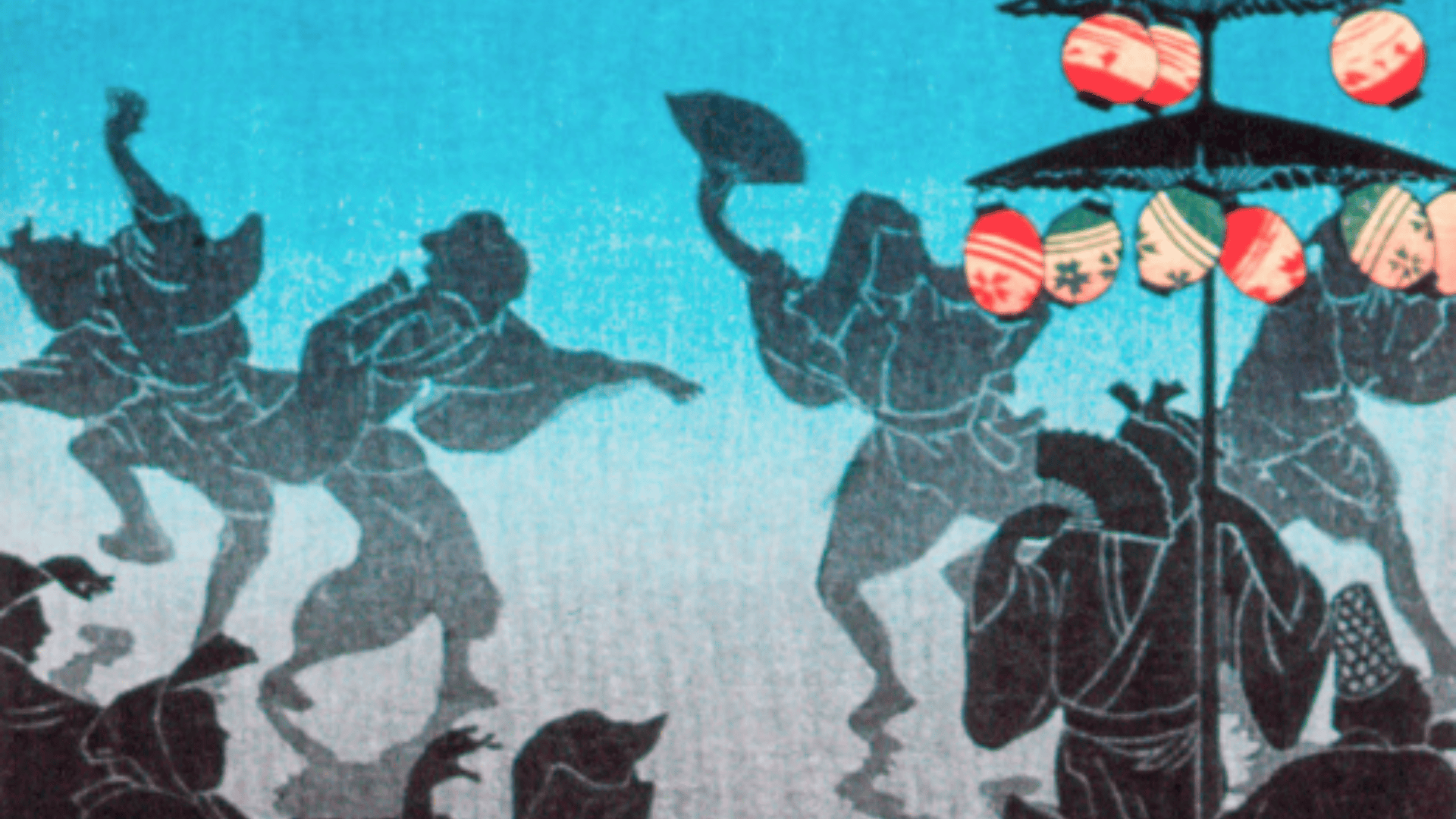
That dance is remembered as the origin of Bon Odori, the circle dancing held in temple yards and parks all through the Obon season. It is worth sitting with the fact that a festival for the dead traces its central ritual back to a moment of relief.
The story establishes a claim, not just a sentiment. In this tradition, the condition of the dead is not fixed, and the dead are not sealed off from the living. Spiritual benefit generated by people who are alive can be dedicated to someone who has died, and it changes their situation. This is why the offerings during Obon are not gestures of remembrance in the way Westerners usually mean that phrase. They are actions performed for someone. Whether or not you share the metaphysics, the difference in posture is significant. Memory is something we do for our own comfort. Obon assumes traffic in both directions.
The practices are tender, and often smaller than you would expect. Families clean the graves and the household altar in the days beforehand. On the first evening a welcoming fire is lit, or lanterns are hung, so the returning spirits can find the right house. Food and drink are set out. A priest may come to read sutras at the altar.
And then there are the animals. Small figures are made from summer vegetables and set on the altar: a cucumber with toothpick legs to serve as a horse, and an eggplant with toothpick legs to serve as an ox. The horse is fast, so the ancestors can come home quickly. The ox is slow, so they can take their time going back and can carry everything they have been given. Even the vegetables are asked to be hospitable.
The ending of the festival is the image most people recognize. On the final night the process reverses. Sending fires are lit. In Kyoto, enormous characters are burned into the hillsides above the city, visible for miles. Elsewhere, lanterns holding small candles are set on rivers and carried out toward the sea in a ceremony called Toro Nagashi. Thousands of lights, moving away in the dark. The guests are being walked to the door.
A note on the dates, because they move. Most of Japan keeps Obon in mid-August, but Tokyo and parts of the east observe it in July, and some rural areas still follow the older lunar reckoning, which drifts from year to year. If you see conflicting dates listed, all of them are probably right for somewhere.
Obon belongs to the tradition that carries it. Bon Odori is not a dance to appropriate, and floating candles down the Yellowstone is a fire hazard and a littering citation rather than an act of devotion. The rituals are not ours.
The premise underneath them is another matter, and it is available to anyone. Set a photograph out this month. Put something on a plate that they liked and would have wanted. Light a candle or a stick of incense and let it burn down for them, without asking for anything. Say the name out loud, which is harder than it sounds if it has been a while, and notice what happens in your chest when you do.
If you want to write instead, try this: sit down with a notebook and record everything you actually know about one person who came before you. Not the sentiment, the specifics. What they ate for breakfast. How they answered the phone. What they were afraid of. Most families lose this within two generations, and no one ever means to.
And if the work asks for company, that is what our readers are here for. Some questions about the people who came before us are better sat with alongside someone else, and our readers keep a rotating weekly schedule at the shop. Stop in, or give us a call at 406-252-4398, and we will tell you who is in this week.
The lanterns at the gate say something simple. You are still ours, we know how to find you, and the door is open. That translates.